

Born Into the System
The Hidden Cost of Commercial Cult Childhoods

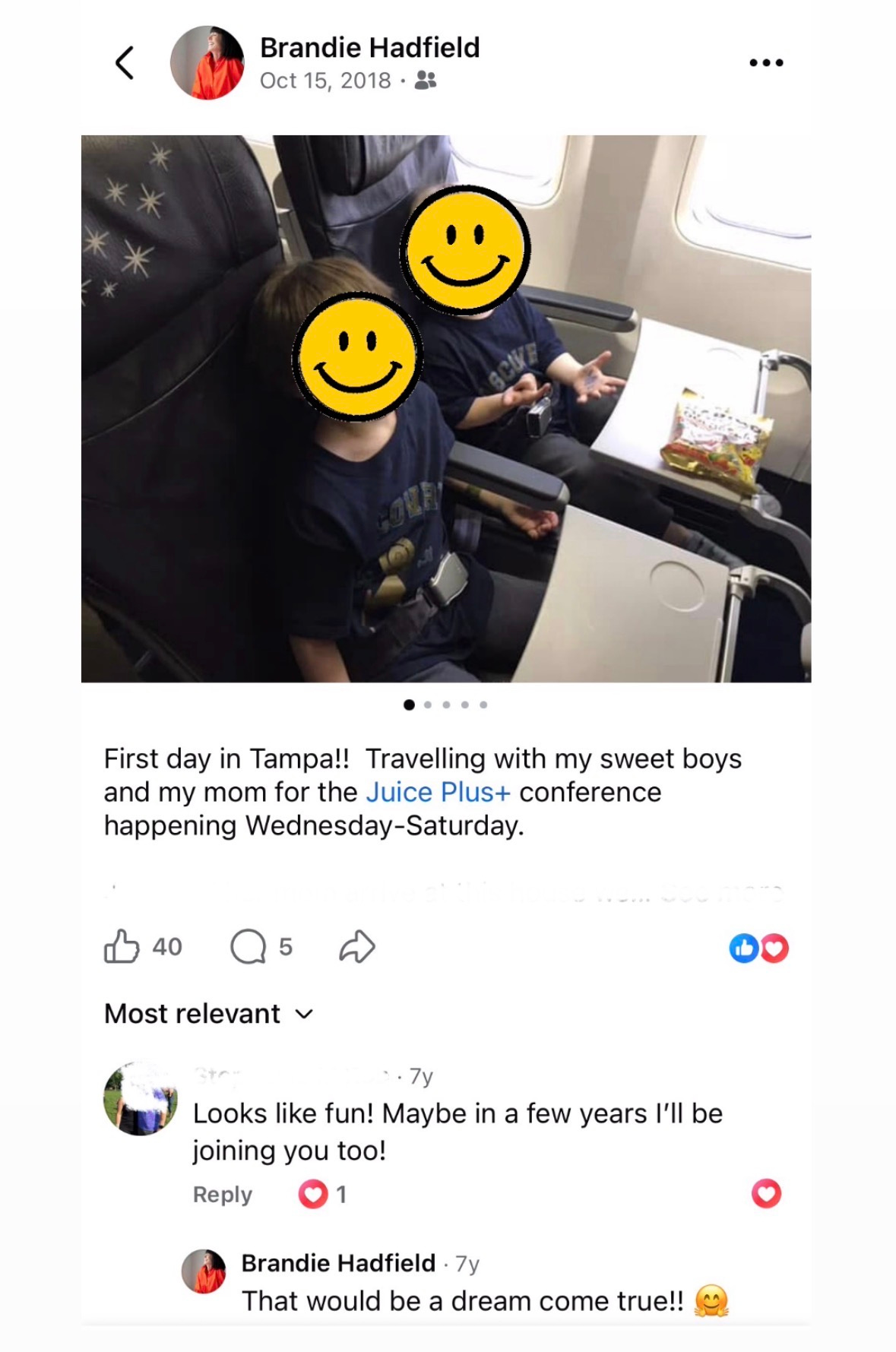
“…pimp out your kids.” That was the end of a sentence, in a stream of advice that Tracy, a leader was giving me on a coaching call I had won.
Just that one example, a blink in my total time in The Company, has loaded layers of manipulation. I won the call. I won this time to be told what to do. I won this because I had overextended myself the previous month doing “income-producing activity” and logging it for my upline. My reward was that my upline set me up for a surprise coaching session; I didn’t know who I would be meeting with. When I entered the Zoom room, I was surprised to see Tracy—a top leader that my upline knew I admired. Tracy, who would be coaching me for the next hour, was a Canadian and a mother, like me. I was not going to waste this gift; I would do what this expert was telling me to do.
“…pimp out your kids.”
In this dynamic, the person who wields the power can say something this horrific, laugh about it, and the person in my shoes will excuse it as a joke, but also kind of serious. Because, the words ‘pimp out’ make you think about profiting off the work of someone you control. But using a child to profit from them is gaining increasing noteriety with children growing up and speaking out to say, “I trusted you, that was wrong, and it stops now.” 1
In every MLM, children are frequently used as props on social media. So when I heard her advice, I didn’t flinch. I was already under this spell, a prolific social media poster, convinced that every photo, every story, every glimpse into our private lives was doing as I was told: getting my audience to “know, like, and trust” me.
It wasn’t until I stepped away from my personal little Truman Show that I realized just how deeply my children’s identities had been commodified. What I thought was harmless sharing was, in truth, exploitation. The more I reflect about all of it, and the more my now older children can articulate their experience from when their mom was a BossBabe, the more MLM-Mom content people forward to me, reading a memoir written by a child Influencer—the more I see the parallels. Children raised inside cults, even what society deems as a harmless MLM, are robbed of consent and agency. They are growing up in a system that grooms them to make the MLM their personality before they can complete the developmental task of identity formation.
MLMs recruit mothers, yes, but also their children.
Before I started whistleblowing, before I had even understood what a commercial cult was, all I knew was that after nearly a decade, my family and I spent too much time on our devices. This is the story of how the crack first appeared, allowing enough light to eventually shine in so we could finally leave.
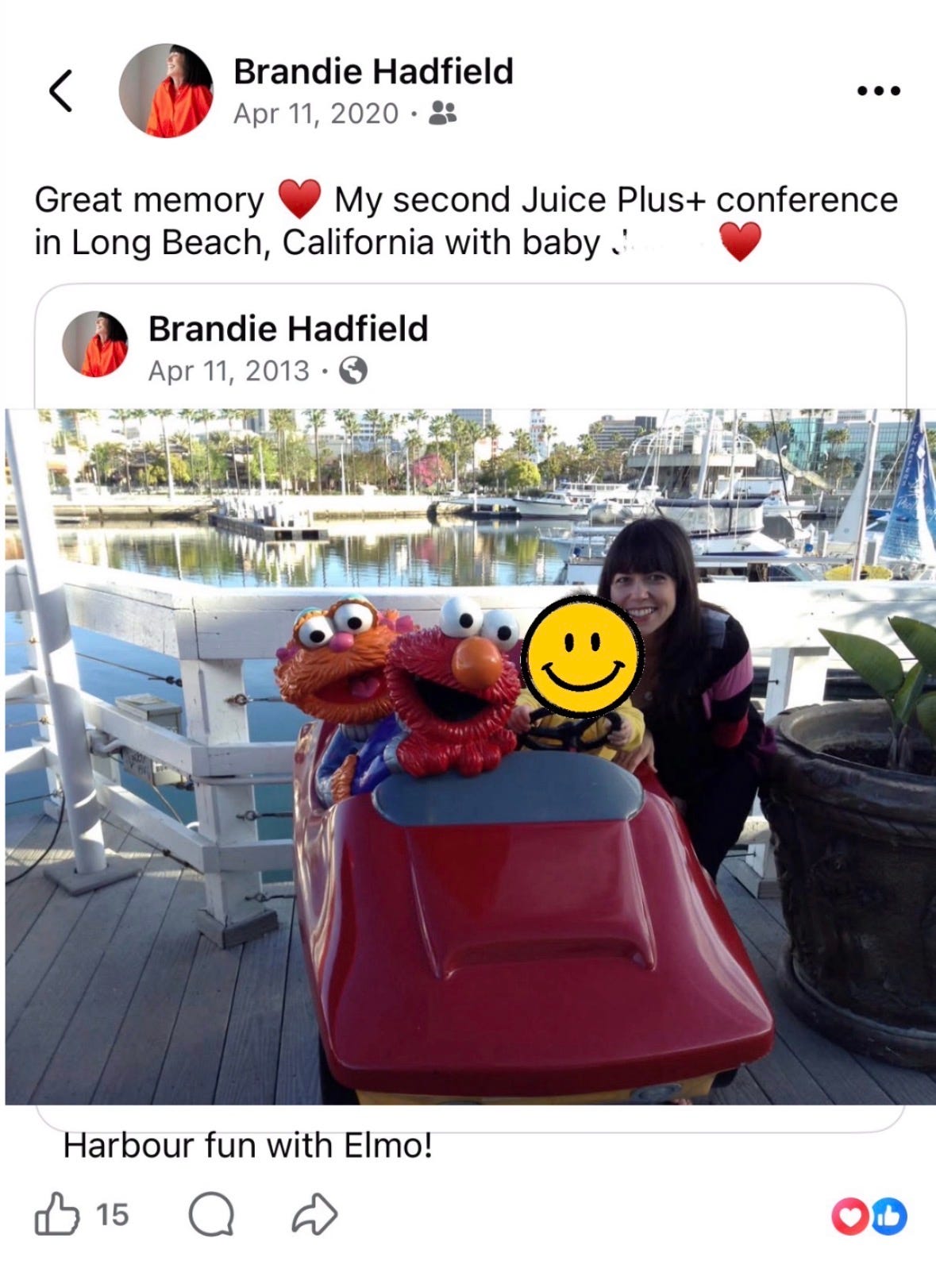
It was actually The Doctor who had initially recruited me who planted the seed that would lead to the demise of my cult identity. I had a team member I’ll call Mona, an evangelical Christian mom and functional nutritionist and someone my uplines wanted to retain at any cost. She became part of my downline initially as a lead given to me by the Coaching program that had funnelled me in. My uplines would throw me bones via free leads because they knew I would successfully convert them to join our downline, and because they wanted to retain me. Mona was exactly the type of person who fit the image of wholesome, “mission-driven-mama” that they wanted all of us to exemplify. So, when Mona announced she was going to quit The Company because of “family stuff,” I knew to book a connection call right away.
Connection calls were not just for recruiting, they were also for deepening the bonds/social reliance of team members and customers, and for retaining team members. We were taught to do this through love-bombing and guilt tactics, which was not what was said explicitly, but it best describes what I participated in, in retrospect.
This is what I wrote Mona, in order to get her to meet with me and my upline, Victoria, in November of 2021:
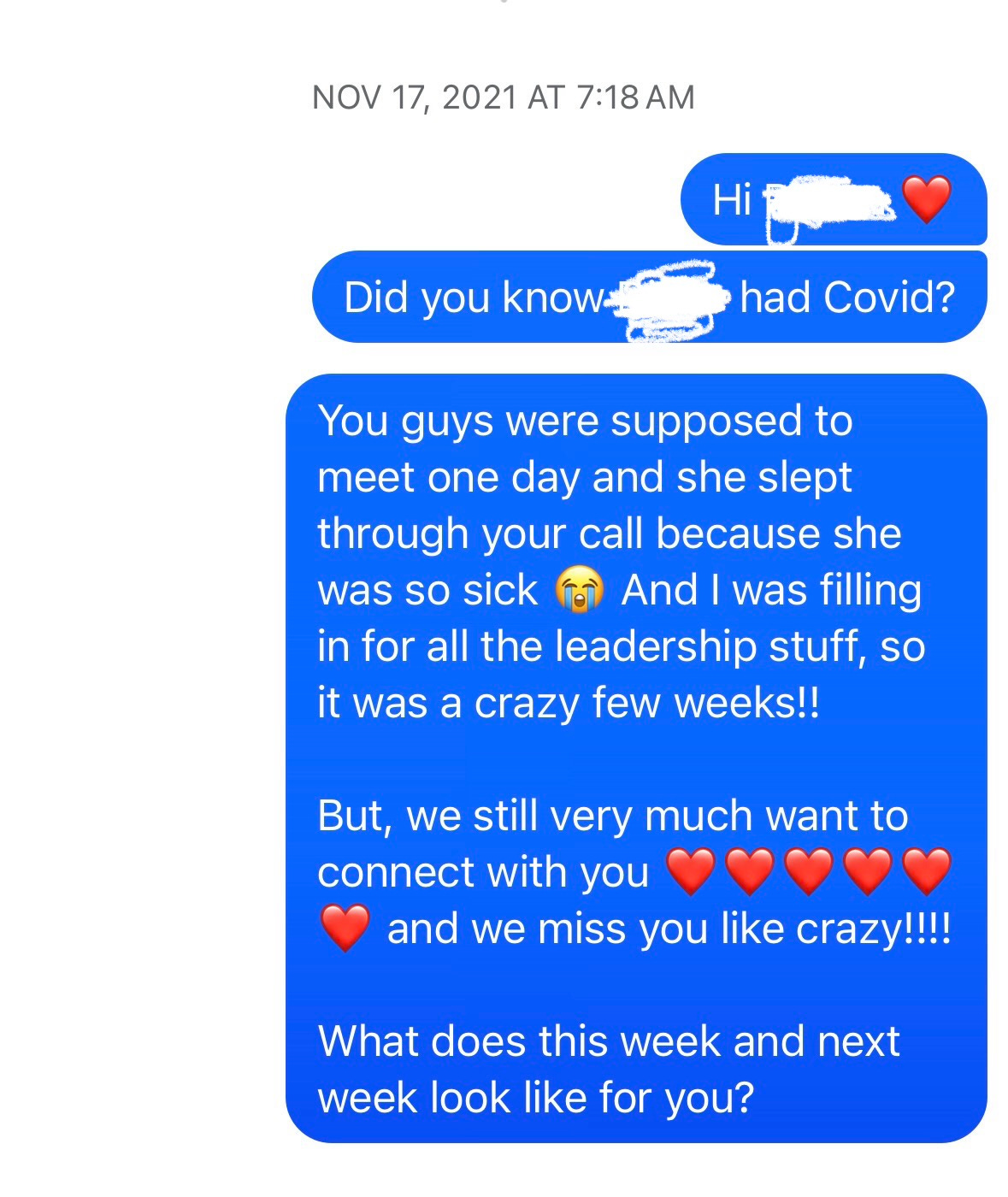
That timestamp though.
While these words felt accessible for me because I did genuinely like Mona, when we spoke with her, we had one goal—to get her to stay enrolled on our team. And she did not want to, and asserted as much. After the call ended, Victoria said, “I have a feeling it’s her husband,” and told me she believed he had an abusively controlling hold over Mona, cementing in me the idea that the “business” I promoted, which I myself was trapped in, somehow helped liberate women.
But the cognitive dissonance was getting more unbearable by the day. Because at this point, the cognitive dissonance was making itself known in my bones. I was trying to figure out how to succeed in an unethical business with integrity and without causing harm to myself and my family. And it was proving to be impossible.
In early summer of 2021, five months before that last‑ditch “connection call” in November, I had attempted to retain and engage Mona by granting her exclusive time with our famous doctor upline. As a “leader,” I could gatekeep access to him in this way, which was one of the unspoken rules of the rigid system I was part of. The rule of these calls was that, as the upline, I remained on mute after the edifying initial introduction to him. The intended impact was that Mona would feel privileged and indebted, just like I did when I was on the coaching call with Tracy being told to “pimp out my kids.” At the same time, my quiet presence positioned me as her direct link to the Doctor, and reinforced my role as her leader. The one who could open doors for her. Mona was having a hard time with her teenage daughter, and while attempting to offer a healthy, broad array of advice (including “doubling up” on the supplements, of course), The Doctor recommended a book he had written the foreword for about screentime limits. Because I took everything The Doctor said as gospel, I ordered the book myself, reading it in less than a week. The unintended consequence was that taking a break from social media and unplugging my kids from gaming would irrevocably break the commercial cult spell (not before I tried to find ways to continue on, to no avail).
After several months offline, my kids and I self-published a book on Amazon called, The Screen-Free Challenge, which included tracker sheets for kids to try going offline for 3, 7, or 30 days, as well as colouring pages and activities for them to do as alternatives to video games. After releasing our book, I relapsed with falling under the spell of using social media to recruit and prospect for The Company. I posted about our book, which garnered a ton of reactions, praise, comments, and subsequent purchases. I was high on the knowledge that I had made a valuable contribution, during this time I was trying to attend team calls again after what I called my “sabbatical,” and was not ready to see the reality of my situation; that working my way to the top wasn’t every going to be possible without exploitation all around, plain and simple. It was/is the name of the game.
Once I started posting on social media again after my family’s screen detox, my thinking patterns reverted back into the mode of filtering thoughts and occurrences through a lens of how they could be turned into content. While on a team meeting Zoom one day, my younger son slipped a note under my door that said, “J cracked his toenail, and there is blood everywhere. By B,” with a sad face and a thumbs down drawn on the page. When I ran out of my bedroom to see if J was OK, he had a smile on his face.
“Are you OK?” I asked.
“Yeah, why?” he replied.
I showed him the note his younger brother wrote.
“Ha! Yeah, I’m fine. He fixed it all up.”
J stuck his foot out to show me a bandaged up big toe. This scene, to me, was precious and extraordinary. To me, it perfectly illustrated the change going screen-free had made in my kids. A year ago, their iPads would have babysat them while I was on a Zoom meeting. Now, they were working together, problem-solving, getting along, and even cleaning up their own blood! My mind played out the photo of the note B wrote, and how I would caption it. The intention, of course, is to recruit into my downline by communicating, “This too, can be you, working parent!” The subtext, “Join my team and let me fix your life.”
The cycle is then perpetuated of me getting high on posting, but then worrying whether it will land the way I intended. Driven to compulsively check the comments and tally the likes as a measurement of my worth. So then I began to view this thought pattern as a sickness I had. Compulsive production to prove I was not a failure. To prove that I had a right to take up any space. I was writing in my journal alot during this time, which helped me connect these dots.
The following day, we went to an indoor play centre, and the boys were running around playing with other kids they didn’t know. Most of whom were in the toddler to preschooler age bracket. This was fine because my kids were thoroughly amused by the younger kids and enjoyed their innocence and the process of winning their adoration. J and B rallied these 2-3-year-olds in games of imagination, and I watched with a twinkle in my eye. I had become extremely self-conscious about scrolling social media during these trips, and I noticed when other caregivers were glued to their phones. I noticed how disturbing it was for the children of these caregivers to not be able to find eyes to connect with during moments of awe, excitement, or worry. I knew I, too, am that phone-addicted parent, and it’s a tug that I tried hard to resist and often couldn’t. I felt like I was my dad driving with me with his Molson Export in the beer cozy, unable to go without.
I started bringing books to read when I took the kids places, and a notebook and pen, but on this particular day, I had neither. I noticed one of the moms wears her phone like a purse. She had on a casual romper without pockets, and an expensive-looking leather purse-strap-thing attached to her phone so she can have it constantly without using her hands. I wondered to myself, since iPhones now have the “wallet” function, you literally don’t need to carry money or debit cards. I tried to decide if I thought this purse-phone-thing was brilliant or fucked up.
J and B snapped me out of my thoughts by suddenly appearing to the group of toddlers sporting matching bee costumes. It was both hilarious and cute because these costumes were clearly too small for their then 6 and 10-year-old frames. They had big smiles on their faces as they got ready to perform a routine they had rehearsed, and the toddlers were delighted. My hand reached quickly into my bag to grab my phone. At that moment, they were both facing me, and if I can move a bit to the right, I’ll only see the backs of their heads, so posting this photo won’t breach their privacy...
J instinctively looked right at me as I mouth, “Can I take your picture?”
“NO!” he mouthed back, then lifting his fist in the air with a scowl that says, “I literally wanna punch you right now!”
B then looked up and made an identical fist/scowl in solidarity with his brother.
My heart dropped.
They went back to the play centre dressing room and take the bee suits off.
“I’m sorry I ruined the moment,” I say.
“You TOTALLY ruined the moment,” J retorted, without missing a beat.
My heart twinged in the way that signals to me that tears were coming.
“I’m sorry,” I say, and I walk back to my little corner of the play centre, blinking.
This might sound innocuous, but for me, it illustrates the true ending of my MLM story. The moment Janja Lalich calls, “the shelf breaking.” The moment I knew the gig was up for how the cult identity had been harming me and my kids and preventing organic moments for years and years.
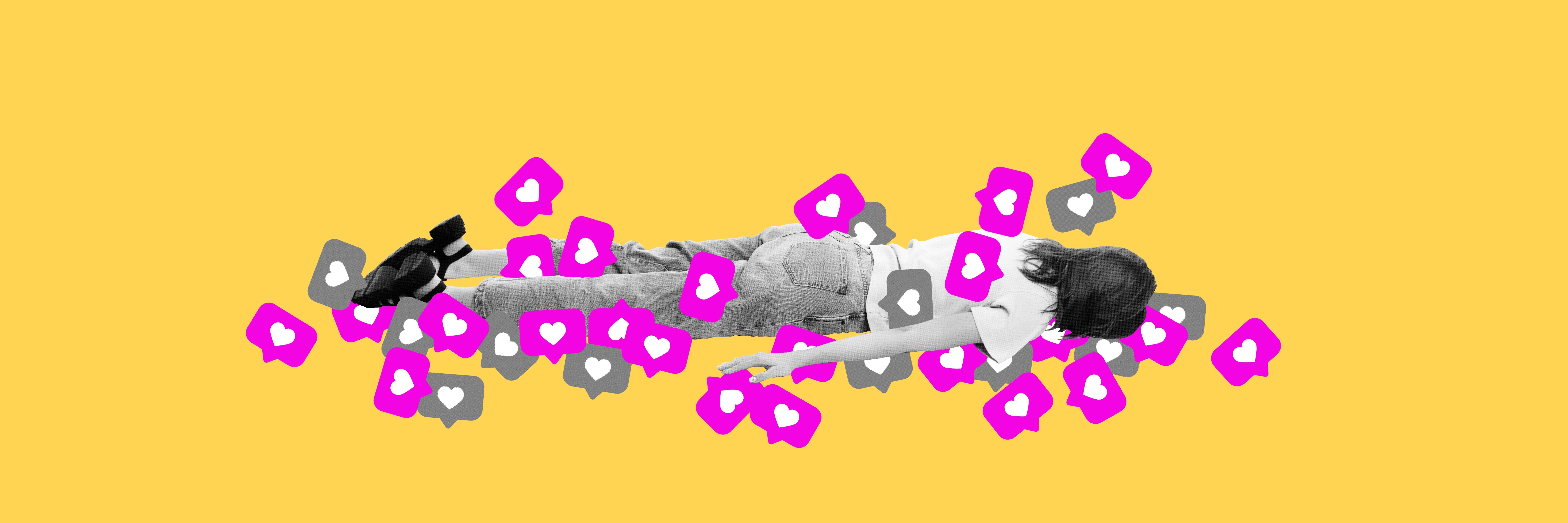
The Implications of a Commercial Cult Childhood
Something I noticed in the cult recovery space is that there are special recovery groups for those “born and raised” inside high control groups, because they require a different level of support from those who enter in later in life. For those of us who join when we’re in our 30s, we can bridge the gaps in our identity lapse by connecting to “before” the cult. For those “born and raised,” they often haven’t experienced an environment conducive to identity formation. When mom makes the cult her entire personality, it impacts the children’s identity formation as well.
What does it mean for the toddler doing unboxing videos on their mom’s Instagram? What the viewer sees is an adorable child who is excited about their vitamin gummies. They see a mom who they perceive as getting to stay home and be present. They read her captions promising that by being part of her downline, you too, can “never miss a moment.” The reality is that the MLM Mom is likely missing most of the moments.
I was trained to see every day through the lens of attraction marketing. I’ll say it again, “Pimp out your kids” meant turning ordinary family life into a nonstop commercial. Instead of playing hide‑and‑seek, my child might watch me prop up my iPhone, waiting as I hand him a box to open while his mirrored image stares back from the screen. When the unboxing ends, he sees me hunched over, editing footage for the next hour—anxious, distracted, and focused on uploading him to my feed. Once the video is live, the cycle continues: recording voice clips, sending invitations to the next event, phoning customers, fielding complaints to head office, refreshing comments, responding to prospects, and squeezing in coaching calls.
My children grew frustrated with a mother whose attention was constantly divided. Many parents know the strain of working from home during the pandemic, but this was different. In a commercial cult, work and life bleed together until there is no separation. Childcare is rarely affordable, since earnings don’t even reach minimum wage. The trip to the library, the snack platter, the bedtime routine—every moment is potential content. And children notice. They see the phone, the editing, the texting team members starting at 7:00am, the nonstop Voxers to listen to, etc. They may not yet be able to articulate it, but they do understand that their lives are being commodified. Beyond the gross commodification of their childhoods, they are living in a real-life “still face” experiment, inextricibly impacting their self-image2
Ed Tronick’s still face experiment shows how infants become distressed when a caregiver suddenly withdraws emotional responsiveness, highlighting the deep need for attunement. In the same way, children born and raised in cults often grow up in environments where real connection isn’t reliable, and is replaced by control, neglect, or manipulation—leaving lasting harms on their ability to trust, regulate emotions, and form healthy relationships.
In a thesis written on the impact of growing up in a cult, the author write,
Leaving a cult produces loss: loss of a belief system, an ideal, death of a dream. Once an individual leaves, he or she is able to have all the feelings that formerly were repressed. The individual then goes through a mourning period of grief and loss.
—Latta, S. L. (2011). Adult children of cults: The experiences of individuals born and raised in a cult as they transition into mainstream society 3
Beyond the issue of social media addiction in parents enrolled in MLM’s and the impact on attachment, there are many more ways in which cult life negatively impacts children. Take every issue of harm that a victim may face—the financial abuse, the impact on identity, the betrayal trauma. Perhaps the parent experiences orthorexia, develops a distrust in doctors outside the MLM and avoids treatments. Often, these children are brought to conferences or incentive trips, where manic episodes are purposely induced4 in their parents through a dopamine hijack created through staged recognition, high‑energy rallies, sensory overload, and group euphoria. When their parent(s) eventually leave, the parent(s) may or may not seek out support, and the children are left to absorb the fallout. They internalize the confusion, instability, and the unspoken expectation to normalize years of bullshit.
Unless we name help them name it. Unless we ask, and answer honestly, how our children have been used in these systems. Every “cute” clip, every staged moment, every performance we orchestrated to turn their childhood into content. We shouldn’t normalize systems that commodify family life for marketing, and that normalize exploitation under this guise of ”not missing a moment.” To protect our children, we need to reclaim our boundaries and create a culture in our homes where childhood is lived and not sold5.
When I left, one of the many tasks I had to do was reclaim my agency as well as my children’s privacy and autonomy. In addition to catching them up on their vaccine schedules, I had to help them untangle the weirdness they experienced from birth to age 6 and 10.
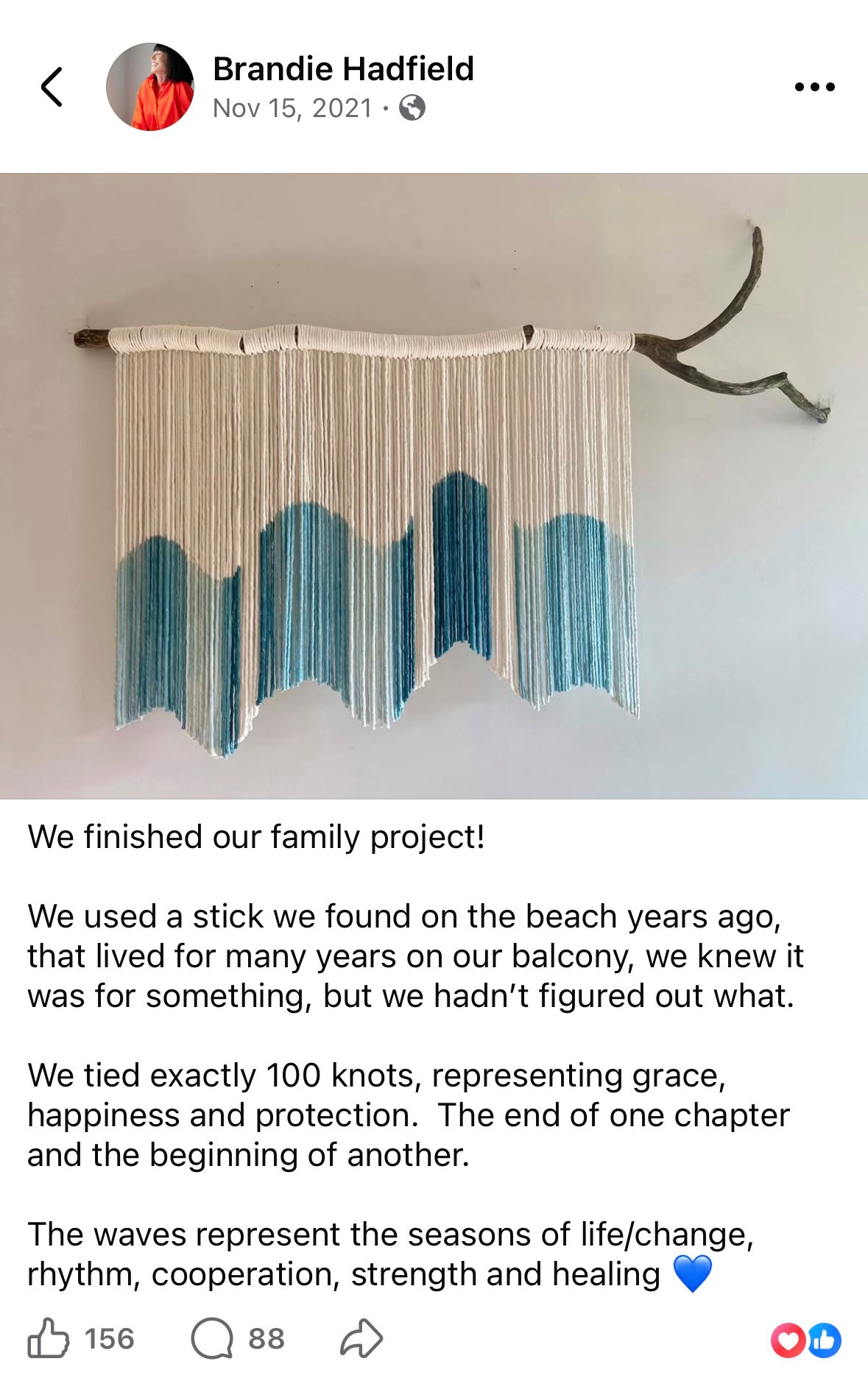
“Remember when we made that thing, and we were showing everyone?”
It’s 8:30 the morning after the play centre incident, and 6-year-old B is pointing to a wall hanging we made. We had used a large tree branch and tied macramé string on it, and then painted a watery wave pattern on each thread.
When he says, “showed everyone,” he means posting it on social media with video clips documenting the creation process, set to psychedelic pop, uploaded to my Stories. This was during my exit process, when it was the beginning of the end but I was still accustomed to sharing our lives as constant public content.
“That was bad,” B says, “for two reasons.”
“One: if we want to show people, we should invite them over to our house to show them. And then we’d have friends over. Which is amazing!”
“Two: they had to go to their phones to see it. We don’t want to encourage people to be on a phone all the time. We don’t want to be on a phone all the time like we used to. See why it’s bad?”
The intention behind this article is to share my personal opinion and experience for informational purposes, from my perspective, and not to malign any specific individual or business entity. Some of the names have been changed to protect the anonymity of those involved.
Sources:
Franke, S. (2025). The house of my mother: A daughter’s quest for freedom. Simon & Schuster.
Mindyourclass. (2016, May 7). Still face experiment Dr Edward Tronick [Video]. YouTube.
Latta, S. L. (2011). Adult children of cults: The experiences of individuals born and raised in a cult as they transition into mainstream society (Master’s thesis, California State University, Chico). California State University ScholarWorks. https://scholarworks.calstate.edu/downloads/4t64gn832
Hunter, J. (2023, October 12). Large Group Awareness Trainings (LGATs) Weaponize Dopamine to Manipulate People. Freedom of Mind. March 14, 2024, https://freedomofmind.com/large-group-awareness-trainings-lgats-weaponize-dopamine-to-manipulate-people-with-john-hunter-phd/
Payne, K. J., & Ross, L. M. (2009). Simplicity parenting: Using the extraordinary power of less to raise calmer, happier, and more secure kids. Ballantine Books.
Loved this Brandie, I relate to this so much. I think my body knew before I knew that it wasn't right for me. Social media became a full time gig not leaving any room for much else. It was all consuming and became so overwhelming that I had many detox days and now I'm a very sporatic user. I was spending less and less time with the people I wanted to spend all of my time with. It didn't add up. I was missing precious time that I can never get back.
Thank you for being so vulnerable and sharing your story 🧡